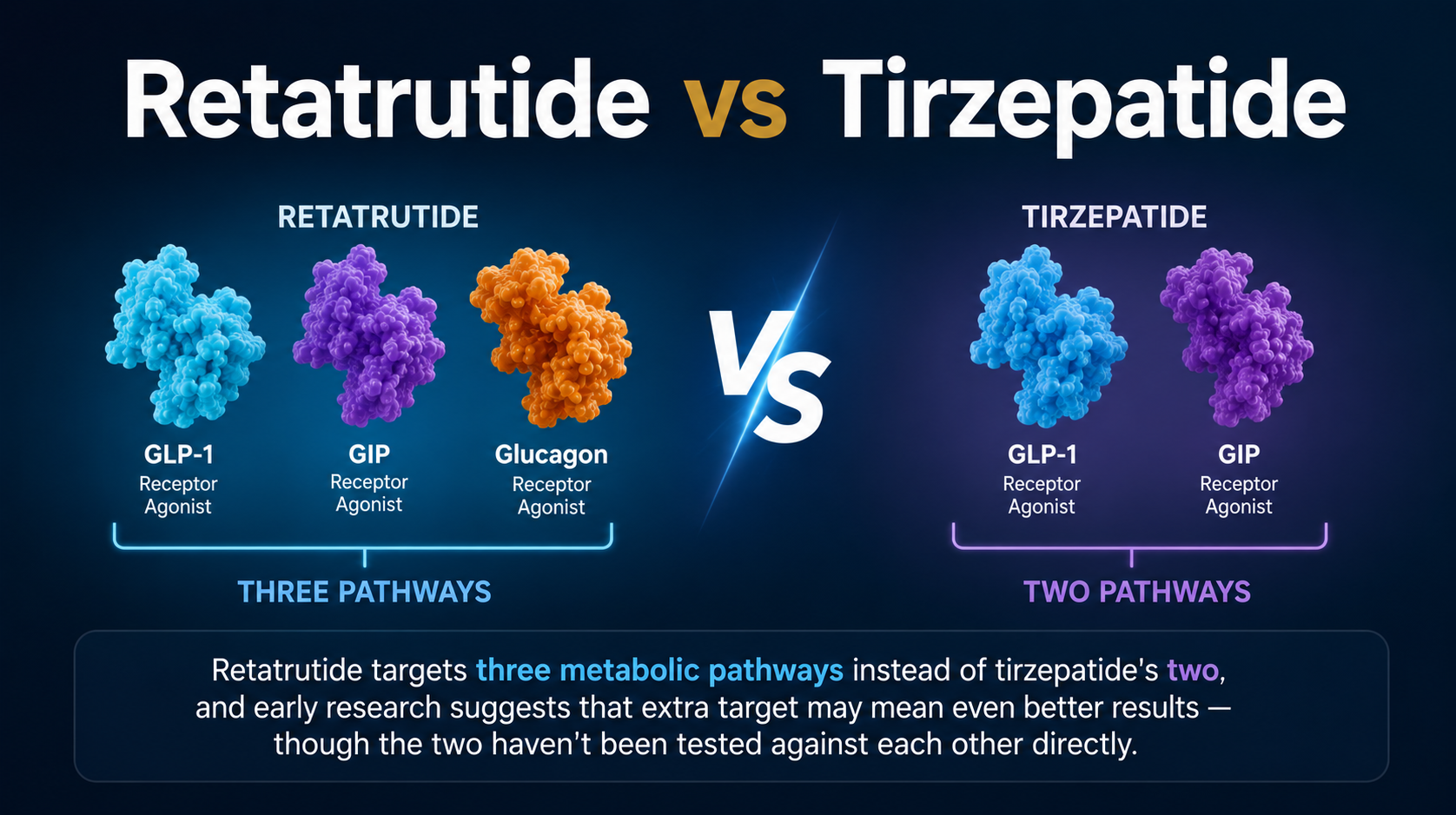
Two hormone receptors got tirzepatide into pharmacies. Retatrutide is betting a third one gets it further. That’s the entire rivalry in one sentence — but the details are where it actually gets interesting.
Tirzepatide didn’t get to where it is by accident. It beat semaglutide in trials designed specifically to settle the question, picked up a second and then third FDA approval, and became the benchmark every new incretin peptide now gets measured against. Retatrutide is the compound trying to clear that bar by doing something tirzepatide doesn’t: working a third hormone pathway instead of two. Does that third lever actually move the needle, or is it just a more complicated way of reaching a similar result? That’s what this comparison comes down to — and right now, nobody has run the one trial that would actually settle it.
This article covers the short answer, how their receptor targets differ, what the research says about each, where each currently stands, and what to know about their separate research-use forms.
The Short Answer
Tirzepatide earned its reputation the hard way — years of large trials, two receptor targets, two FDA approvals, and wins against semaglutide in trials built specifically to compare them. It’s not the new kid anymore. It’s the benchmark.
Retatrutide is the compound everyone in the field keeps half an eye on. It adds a third target that most drugs in this class don’t touch, and its early trial numbers are big enough to raise eyebrows. But “big enough to raise eyebrows” and “proven” are two different things, and retatrutide is still firmly in the first category.
The honest caveat, worth repeating: nobody has run a trial putting these two directly against each other. Every comparison here is built by placing separate trials side by side — a bit like judging a race by two athletes’ personal-best times instead of actually putting them on the same track.
Receptor Targets Compared
GLP-1 — the pathway both drugs share, and the one nearly every peptide in this category is built around. It slows digestion, increases fullness, and helps the body release insulin when blood sugar rises.
GIP — also shared by both. It works alongside GLP-1 to improve insulin response and appears to influence fat metabolism. Tirzepatide leans on this receptor so heavily that some researchers describe it as more of a “GIP drug with GLP-1 support” than the reverse.
Glucagon — retatrutide’s solo move. Activating the glucagon receptor is thought to increase energy expenditure and break down fat in the liver, layering a “burn more” effect on top of the “eat less” effects the other two pathways already provide. Tirzepatide skips this pathway entirely — either a missed opportunity or a sign that two well-tuned levers are already doing plenty, depending on which side of that debate you land on.
Two levers versus three. The open question in the field isn’t really whether GLP-1 and GIP work — that part is well established by now. It’s whether the third lever adds enough extra effect to justify a more complex mechanism, or whether two well-tuned pathways are already close to the ceiling.
What the Research Examines
Tirzepatide’s file is thick. The SURPASS program established its effects on blood sugar in type 2 diabetes; the SURMOUNT program did the same for weight, with the highest studied dose (15 mg) producing about 20.9% average weight loss at 72 weeks. It’s been tested directly against semaglutide more than once, and came out ahead each time. Beyond its two current approvals, it’s now being studied for liver disease and cardiovascular outcomes too.
Retatrutide’s file is thinner, but it reads like a highlight reel. The Phase 2 trial (published in the New England Journal of Medicine, 2023) reported mean weight reductions of up to approximately 17.5% at 24 weeks, with larger reductions observed over longer follow-up. Phase 3 trials — the TRIUMPH program — are now testing it in bigger, more varied groups, including people with obesity and cardiovascular disease. What retatrutide doesn’t have yet is tirzepatide’s track record: no completed Phase 3 program, no long-term outcomes data, and no trial that puts it in the ring with tirzepatide directly.
Line the two files up side by side, and retatrutide’s headline weight-loss numbers look like they might edge out tirzepatide’s at comparable time points. That’s exactly the kind of cross-trial comparison researchers are trained to distrust, though — different populations, different dosing, different durations can all quietly tilt the scoreboard without anyone doing anything wrong.
Where Each Is Studied
Tirzepatide is approved and actively prescribed under two brand names — Mounjaro for type 2 diabetes, and Zepbound for weight management and obstructive sleep apnea — and it keeps getting studied for more.
Retatrutide, for now, exists entirely inside clinical trials. No approved use, no pharmacy listing — just the Phase 3 TRIUMPH program, which is where the evidence for any future approval will have to come from.
That gap says more about where things stand than any percentage in a trial report: one compound you can pick up with a prescription, the other you can only find inside a study.
Research Use Considerations
Both compounds are also sold separately as research peptides, entirely apart from tirzepatide’s approved prescription products or retatrutide’s ongoing clinical trials. That research-use material is not the approved drug, not an investigational drug supplied under a trial protocol, and not intended for personal or human use in any form.
Blueprint Sciences supplies retatrutide with a certificate of analysis for every batch, so you can check the numbers yourself before using it in a study. You can view the current listing here: Retatrutide 10mg – Research Use Only.
A few things apply to handling either compound in a research setting:
- Both are typically supplied freeze-dried and need to be reconstituted with a sterile diluent before use.
- Once mixed, both are considerably less stable than in freeze-dried form and should be stored cold, away from light, and used within a defined window.
- A certificate of analysis (COA) tied to the specific batch — confirming both purity and identity — is the main way to verify what a research sample actually contains.
Using either compound outside of a legitimate research setting, or in place of an approved medication or clinical trial protocol, isn’t something we support or recommend.
This article is for general educational purposes only and isn’t medical advice. Tirzepatide is approved by the FDA under specific brand names for specific indications, when prescribed and dispensed as those approved products. Retatrutide is an investigational compound and is not approved by the FDA or any regulatory authority for any use. Both compounds, when sold for research purposes, are separate, non-prescription products, strictly for laboratory research use, and are not for human or animal consumption.