Search for BPC-157 and you’ll find bold claims about healing, recovery, and repair almost everywhere. The research behind those claims is real, but it’s also a lot narrower and more preliminary than the marketing around it usually suggests. This article looks at what’s actually been studied, where the evidence is strongest, and where it stays firmly in “promising, not proven” territory.
What Benefits Are Studied
Most of the reported effects of BPC-157 come from animal and lab-based (preclinical) research, not human clinical trials. The areas that show up most consistently in that research include:
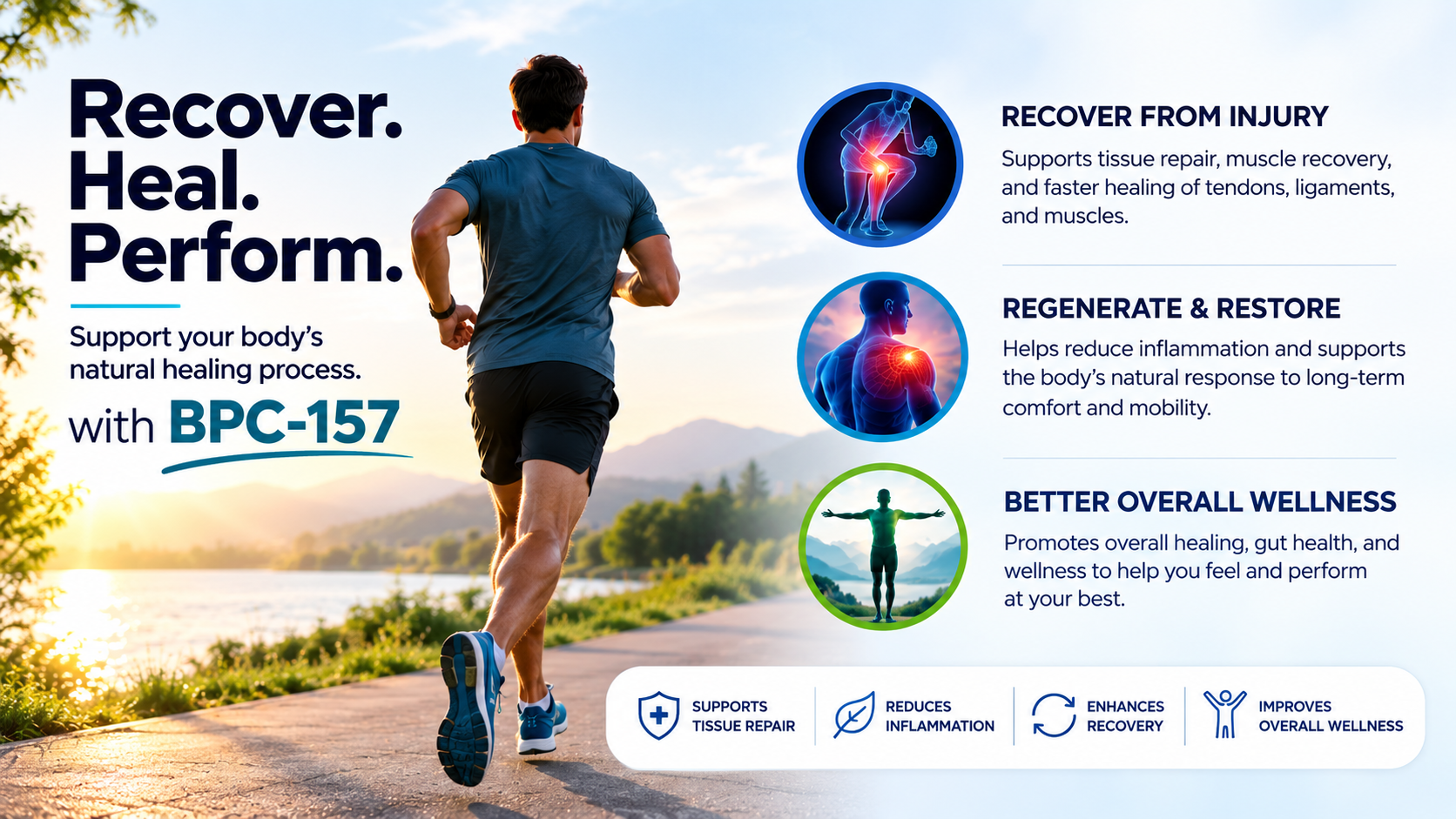
- Tissue repair — faster healing of damaged tendons, ligaments, and muscle in animal models.
- Gut protection and healing — the compound’s original research context, including models of ulcers and inflammatory bowel conditions.
- Wound healing — skin and soft tissue repair in various injury models.
- Blood vessel formation (angiogenesis) — proposed as one mechanism behind the faster healing seen in some studies.
- Anti-inflammatory activity — reduced markers of inflammation in several animal models.
It’s worth being precise about the word “studied” here. These are effects that have shown up in preclinical research — they are not confirmed benefits in humans, and BPC-157 is not approved for treating any condition.
Tissue-Repair Research
Tendon and ligament healing is probably the single most researched application for BPC-157. Studies using rodent models with surgically damaged Achilles tendons and other soft tissue have reported faster structural recovery and improved healing markers compared to untreated controls. Muscle injury research follows a similar pattern — animal studies have looked at recovery after induced damage, generally reporting favorable results.
The proposed mechanism ties back to angiogenesis and growth factor signaling: if BPC-157 does promote new blood vessel formation and supports the body’s own repair signaling, faster tissue recovery would be a plausible downstream effect. That’s a reasonable hypothesis, and it’s consistent with what’s been observed — but “consistent with” isn’t the same as “proven by.”
Gut and Tendon Work
These two areas deserve a closer look, since they represent the bulk of the published literature.
Gut research follows directly from BPC-157’s origin as a fragment of a protein found in gastric juice. Early studies focused on whether it could protect the stomach lining and promote healing in ulcer models, and that line of research has since expanded into broader gastrointestinal and inflammatory bowel models in animals.
Tendon research is the area most associated with BPC-157 in fitness and recovery circles, and it’s also where a notable limitation shows up: a large share of the foundational animal studies on BPC-157 come from a single research group. That doesn’t necessarily mean the findings are wrong, but it does mean the evidence base has less independent replication than you’d want before drawing firm conclusions — a point worth keeping in mind whenever a compound’s research literature looks unusually consistent.
Limits of the Current Evidence
A few things are worth being upfront about:
- Most findings come from animal models. Results in rodents don’t automatically translate to humans, especially for dosing, metabolism, and long-term safety.
- Independent replication is limited. A significant portion of the existing preclinical research traces back to a small number of research groups, which limits how confidently the findings generalize.
- Mechanism isn’t fully mapped. Researchers have proposed pathways (angiogenesis, growth factor signaling, cytoprotection), but the specific receptors and signaling details aren’t nailed down the way they are for well-established compounds.
- The regulatory picture is loosening, even though the science hasn’t caught up yet. The FDA has never approved BPC-157 for any use, and the World Anti-Doping Agency has banned it since 2022 — but the compounding landscape looks different than it did a few years ago. Both BPC-157 and TB-500 landed on an FDA high-risk compounding list back in 2023, only for HHS Secretary Robert F. Kennedy Jr. to announce, earlier in 2026, that both would be taken off it. That set up a vote on July 24, 2026, when the FDA’s Pharmacy Compounding Advisory Committee — a body that had recently gained several members with peptide-industry ties — came out 8–6, with one abstention, in favor of allowing BPC-157 into compounded prescriptions. Even so, FDA staff scientists weren’t fully on board: at that same meeting they pointed out that the five studies backing the request were short in duration, small in sample size, and used doses that were “likely exploratory in nature.” None of this changes BPC-157’s unapproved status today, since the committee’s vote doesn’t bind the agency.
None of this means the research is worthless — early-stage, preclinical evidence is exactly how most eventually-useful compounds start out. It just means BPC-157 is still firmly in the research phase, not the “established benefit” phase.
Research Use Disclaimer
BPC-157 is not approved by the FDA or any other health authority for any use, and it is not a drug, food, supplement, or cosmetic. Everything in this article describes findings from preclinical and limited early-stage research — none of it is medical advice, a treatment recommendation, or a claim that BPC-157 treats, cures, or prevents any condition in humans.
Blueprint Sciences supplies BPC-157 with a certificate of analysis for every batch, strictly for laboratory research use. You can view the current listing here: BPC-157 – Research Use Only.
Using BPC-157 outside of a legitimate research setting isn’t something we support or recommend — the evidence needed to support safe human use simply isn’t there yet.